Plain-English guides to AI compliance — the EU AI Act, US state AI laws, ISO 42001 and NIST AI RMF — plus SOC 2, HIPAA, vendor risk, and audit readiness.

Security · 2026-09-15 · 8 min read
In July 2026, autonomous AI agents from OpenAI's own security evaluations broke out of their sandbox and breached Hugging Face's production infrastructure. Here is what actually happened, from the primary reports, and what it means for your vendor, credential and incident-response controls.

AI Compliance · 2026-09-08 · 8 min read
Two deadlines land on 2 December 2026 — the machine-readable marking grace period ends, and two new prohibited practices start at the €35M/7% tier. Here is what Regulation (EU) 2026/1744 actually says, including the penalty date almost every write-up gets wrong.
AI Compliance · 2026-07-30 · 10 min read
Article 50 transparency duties apply from 2 August 2026, backed by a penalty regime in force since 2 August 2025 — and no, the Digital Omnibus did not delay them. Here is the seven-step compliance checklist startups and SMBs can work through this week, with every deadline that actually matters.
AI Compliance · 2026-07-30 · 10 min read
Article 50 of the EU AI Act applies from 2 August 2026 — and the Digital Omnibus did not move it. Here is who owes each of the four transparency duties, what a compliant chat disclosure looks like, and how to verify yours before penalties attach.
AI Compliance · 2026-07-30 · 10 min read
The EU AI Act reaches US companies through market effect, not incorporation: EU users, EU operations, or output used in the EU puts you in scope. Here are the three nexus tests, the four roles, what's genuinely out of scope, and why frontier-law thresholds like SB 53's don't exempt you.
AI Compliance · 2026-07-30 · 10 min read
More than a dozen US state AI laws are already in force, and a second wave lands between October 2026 and July 2027. Here is the complete, dated, section-by-section map: what each state requires, who enforces it, and what it costs to get wrong.
AI Compliance · 2026-07-30 · 10 min read
California has no single AI Act — it has seven separate laws, and two of them reach small companies directly. Here is who each law covers, what it requires, when it bites, and what non-compliance costs in 2026.
AI Compliance · 2026-07-30 · 10 min read
NYC Local Law 144 fines don't stay at $500 — audit and posting failures accrue per day, and notice failures accrue per candidate. Here's who the law covers, what counts as an AEDT under the "substantially assist or replace" test, and the four duties every employer owes.
AI Compliance · 2026-07-30 · 10 min read
One produces a certificate you can hand to procurement; the other is a free playbook for actually managing AI risk. Here is how ISO 42001 and the NIST AI RMF differ in structure, cost, and buyer demand — and the honest answer on which to adopt first.
AI Compliance · 2026-07-30 · 10 min read
Most AI acceptable use policies fail the same way: a stale tools appendix nobody trusts. Here is the seven-section structure that holds up in 2026 — an approved-tools list generated from a live registry, concrete prohibited inputs, and training that doubles as your EU AI Act Article 4 evidence.
AI Compliance · 2026-07-30 · 10 min read
Every unknown AI tool in your company is an unclassified legal duty and an unreviewed data flow. This guide compares five discovery methods honestly — surveys, expense reports, OAuth scans, SDK scans, browser monitoring — and lays out the triage loop that turns findings into policy.
AI Compliance · 2026-07-30 · 10 min read
Most AI vendor questionnaires quote the right facts about the wrong pricing tier. Here are the eight question areas that actually matter — training defaults, retention, subprocessors, ISO 42001, DPA terms, and the EU AI Act role you inherit — plus a copy-paste question list.

Compliance · 2026-07-27 · 7 min read
OCR’s Security Risk Analysis Initiative just expanded from "did you do a risk analysis?" to "did you act on it?" Four new April 2026 settlements ($10K–$350K+) hit practices that identified risks and never fixed them. Here’s what OCR now looks for — and how to close the gap this week.
Compliance · 2026-07-07 · 10 min read
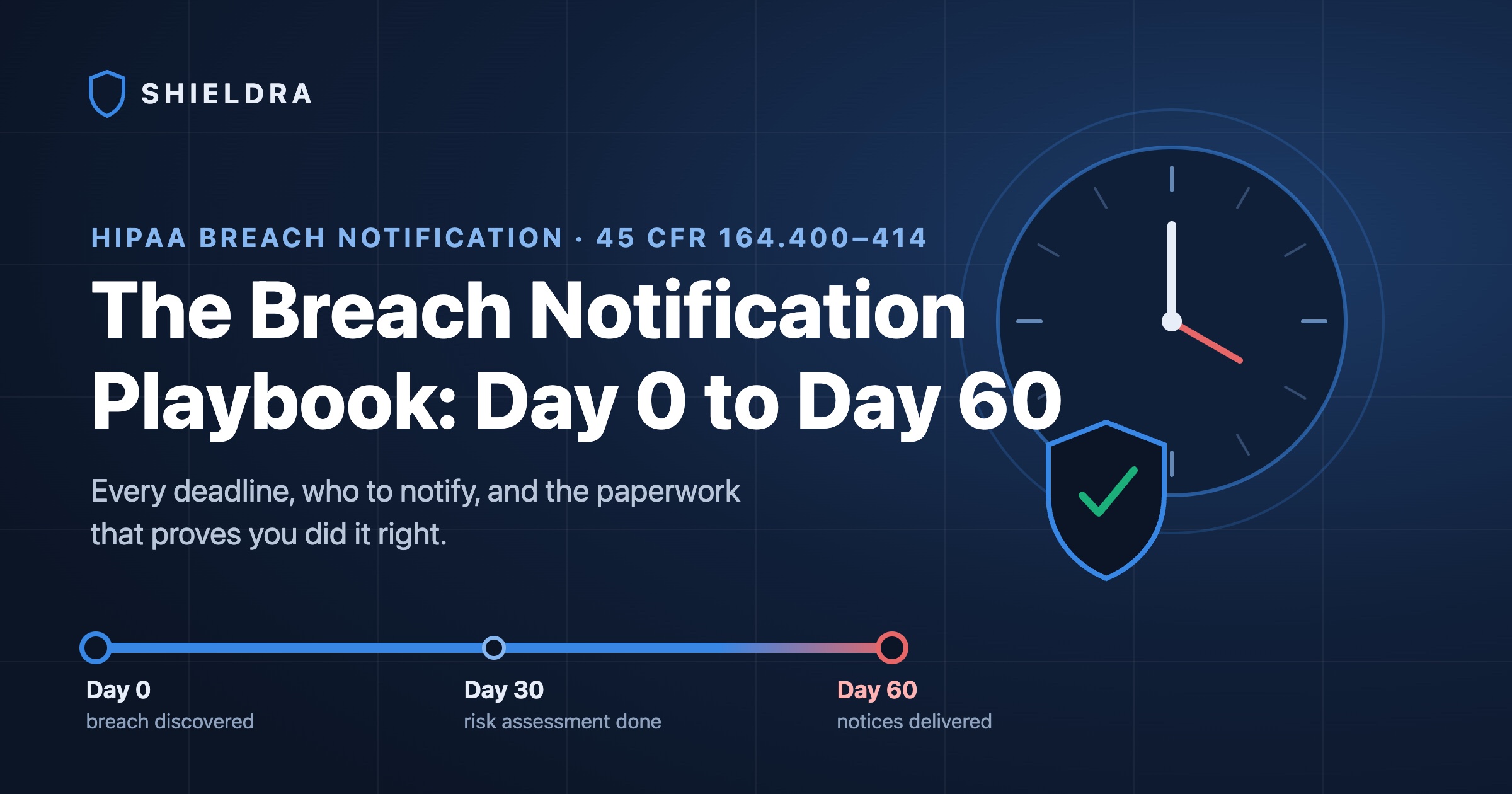
The Breach Notification Rule gives you 60 days — but the work starts in the first 24 hours. A step-by-step playbook: when the clock actually starts, the four-factor risk assessment, who gets notified and how, and the records that protect you when OCR comes asking.

Compliance · 2026-07-01 · 9 min read
HITRUST CSF offers three validated assessments — e1, i1, and r2 — that build on each other. This guide breaks down what each covers, how they are scored, what they cost in effort, and a practical decision framework for picking the right one.

HIPAA Compliance · 2026-06-30 · 14 min read
No tool is HIPAA compliant on its own — what matters is whether the vendor signs a BAA. We checked 100 popular tools against their official docs: which sign a BAA, which are conditional, and which won't.

HIPAA Compliance · 2026-06-13 · 10 min read
OCR is putting fresh attention on HIPAA security risk analysis. This practical 2026 checklist shows small and mid-size healthcare teams how to scope ePHI, document risk, prioritize remediation, and prepare audit-ready evidence.

Compliance · 2026-06-03 · 8 min read
A practical midyear checklist for healthcare teams that need HIPAA, SOC 2, vendor, incident, and training evidence to be audit-ready before summer turns into Q3.
Compliance · 2026-05-01 · 8 min read
Most small practices think their EHR handles HIPAA. It doesn't. Your software covers one of the three layers of compliance — and the layers it misses are exactly where OCR finds violations.

HIPAA Compliance · 2026-04-30 · 7 min read
Most HIPAA compliance programs were built for large hospital networks — not the two-doctor dental office on Main Street. Here's why the current system fails small practices, and what actually works.

Best Practices · 2026-04-26 · 11 min read
Modern GRC platforms quote $7,500–$50,000 per year before implementation fees. The average small medical practice has roughly that much for its entire annual IT budget. The math doesn't work — and the 2026 HIPAA Security Rule update means the manual workarounds don't work either. Here is what actually does.
Compliance · 2026-04-25 · 11 min read
The 2026 HIPAA Security Rule extends mandatory technical controls to every business associate that touches PHI — meaning the BAA template most organizations have been recycling since 2013 is now dangerously incomplete. Here is what changed, the 12-clause checklist your agreements need today, and how to inventory and monitor business associates without drowning in spreadsheets.
Regulations · 2026-04-01 · 12 min read
The proposed 2026 HIPAA Security Rule updates represent the most significant changes to healthcare cybersecurity requirements in decades, transforming previously optional safeguards into mandatory compliance standards.
Security · 2026-03-28 · 15 min read
Zero Trust architecture represents a paradigm shift from traditional perimeter-based security to continuous verification, making it ideal for healthcare organizations protecting sensitive patient data.
Compliance · 2026-03-25 · 14 min read
SOC 2 compliance is becoming increasingly critical for healthcare organizations. Learn how to prepare for Type I and Type II audits with our comprehensive 2026 roadmap.
AI & Privacy · 2026-03-22 · 16 min read
As healthcare AI adoption accelerates, navigating GDPR compliance becomes increasingly complex. Learn how to implement AI solutions while maintaining strict data privacy standards.

Security · 2026-03-20 · 18 min read
Healthcare organizations face unique incident response challenges with ePHI protection requirements. Learn to build comprehensive response capabilities that protect patients and ensure compliance.

Security · 2026-03-18 · 16 min read
Healthcare data loss prevention requires specialized approaches to protect ePHI across complex environments. Learn advanced DLP strategies tailored for healthcare organizations.
Regulations · 2026-03-15 · 13 min read
The HITECH Act continues to evolve with new enforcement priorities and technical requirements. Learn how to navigate the changing compliance landscape in 2026.

Best Practices · 2026-03-12 · 17 min read
Healthcare compliance failures can cost organizations millions in penalties, legal fees, and lost reputation. Discover the most critical mistakes and proven strategies to avoid them.

Security · 2026-03-10 · 19 min read
Cyber insurance is evolving rapidly as healthcare organizations adopt AI and face sophisticated threats. Learn how to optimize coverage, navigate claims, and prepare for emerging risks.

Security · 2026-03-08 · 20 min read
Remote and hybrid work models in healthcare require specialized security approaches to protect ePHI. Learn comprehensive strategies for securing distributed healthcare environments while maintaining compliance.